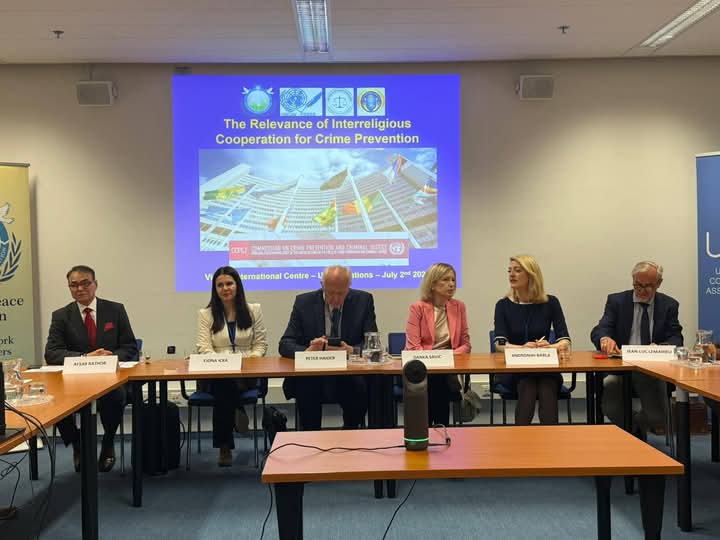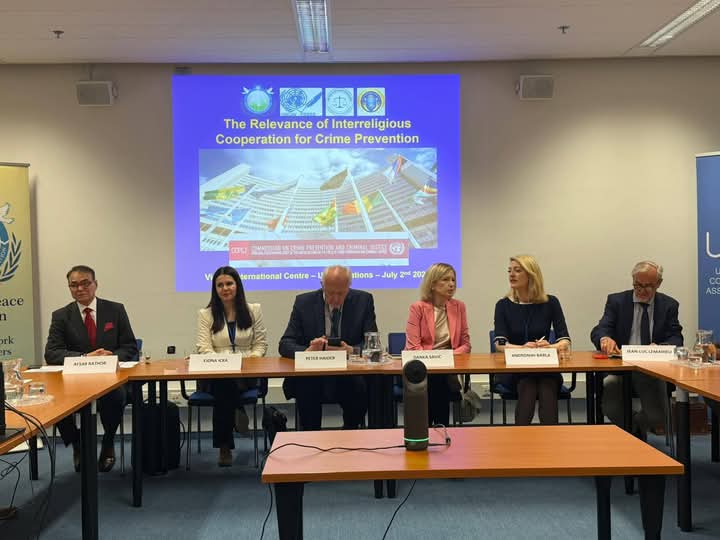



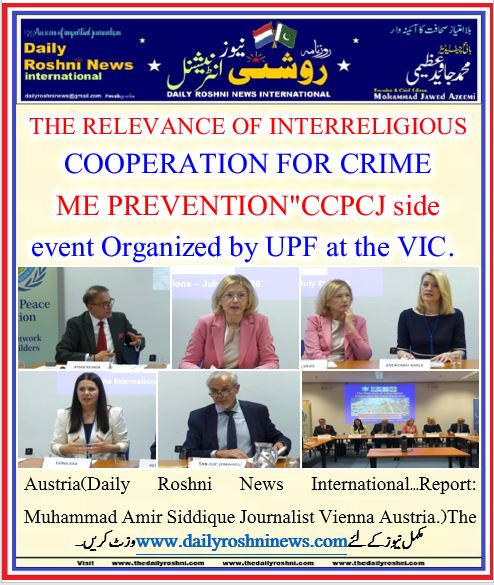
THE RELEVANCE OF INTERRELIGIOUS COOPERATION FOR CRIME PREVENTION”CCPCJ side event Organized by UPF at the VIC.
Austria(Daily Roshni News International…Report: Muhammad Amir Siddique Journalist Vienna Austria.)The United Nations in Vienna brought experiences from regions that have suffered wars, conflicts, and social divisions. Despite their diverse backgrounds, they reached a common conclusion: Crime prevention begins where people feel like part of society—and not its victims. What happens in a society before a young person becomes radicalized? Before hatred turns into violence or disagreements become crimes? From Bosnia and Herzegovina to Kosovo, Rwanda, and Pakistan, participants at an event at the United Nations in Vienna. This central question was the focus of a side event during the meeting of the United Nations Commission on Crime Prevention and Criminal Justice (CCPCJ) at the Vienna International Centre. The event, titled “The Relevance of Interreligious Cooperation for Crime Prevention,” was organized by the Universal Peace Federation (UPF) in cooperation with the Coalition of Faith-Based Organizations (CFBOs), the International Association of Youth and Students for Peace (IAYSP), and the United Nations Correspondents Association Vienna.
The event was opened by Mr. Peter Haider, President of the Universal Peace Federation Austria. In his welcoming remarks, he emphasized that the discussion about security should not be limited to state institutions and legal measures. Rather, the role of communities, religious groups, and civil society actors must also be considered when it comes to building trust and preventing conditions that foster violence and crime. In this context, Mr. Haider recalled the words of Martin Luther King Jr. and Nelson Mandela about the importance of dialogue, mutual understanding, and human encounter. Fear and hatred, he said, often arise where communication is lacking and prejudices take the place of personal experience.
Among the panelists who delivered their speeches on the occasion were:-
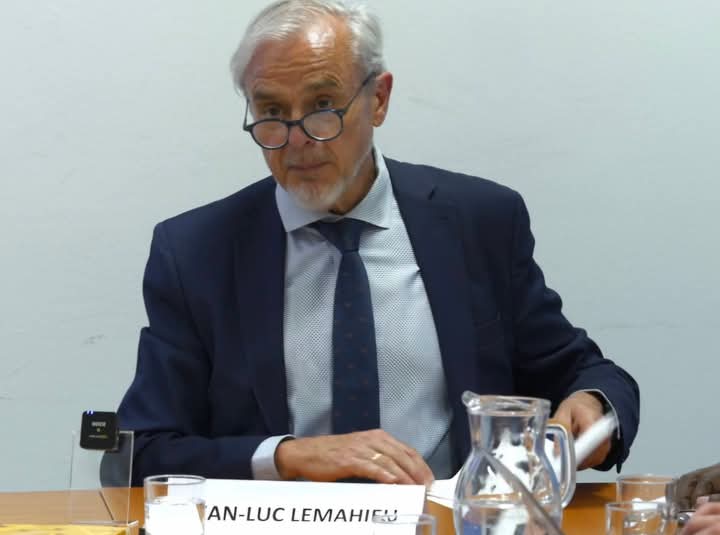
JEAN-LUC LEMAHIEU, former Director of Policy and Public Affairs at the UNODC
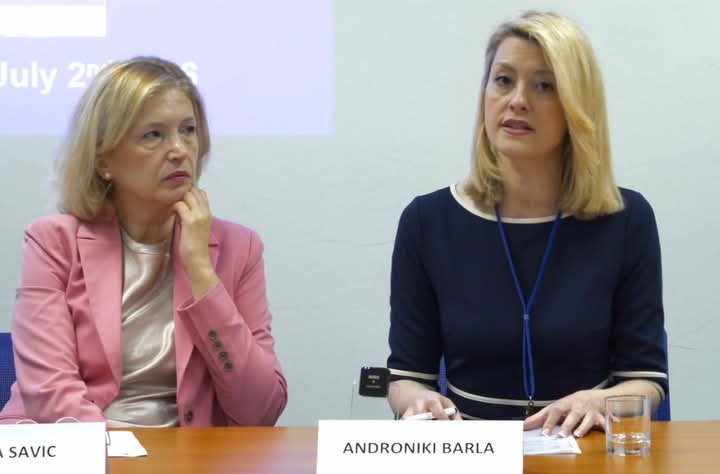
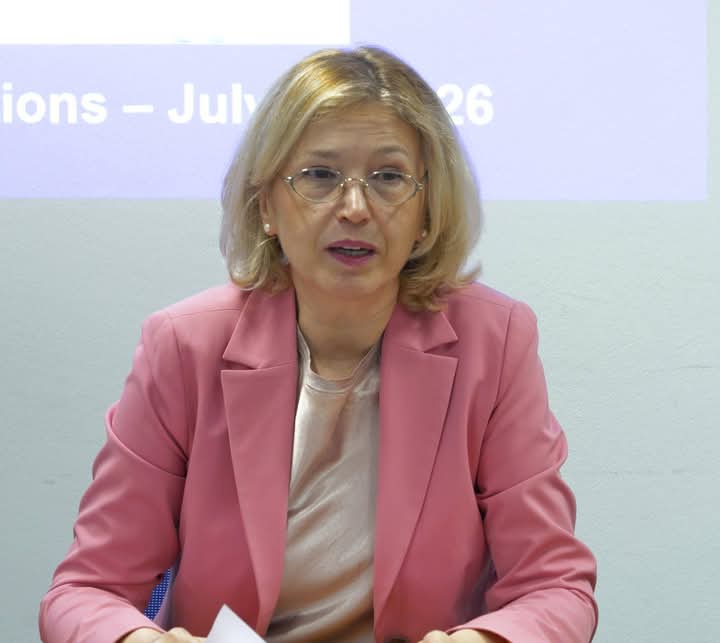
AMBASSADOR DANKA SAVIC, Ambassador of Bosnia and Herzegovina to the OSCE/UN
-
ANDRONIKI BARLA, Theologian and Orthodox canon lawyer
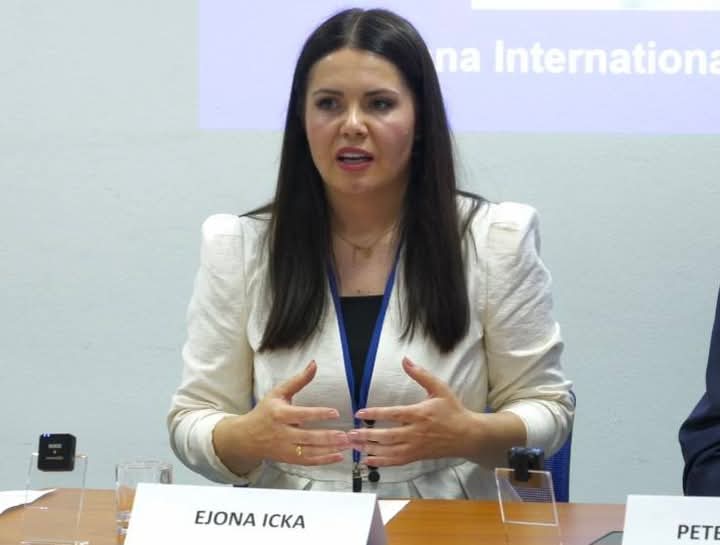
PROF. EJONA ICKA, Clinical Psychologist, UBT University Pristina, IAYSP Balkan Executive Director
-
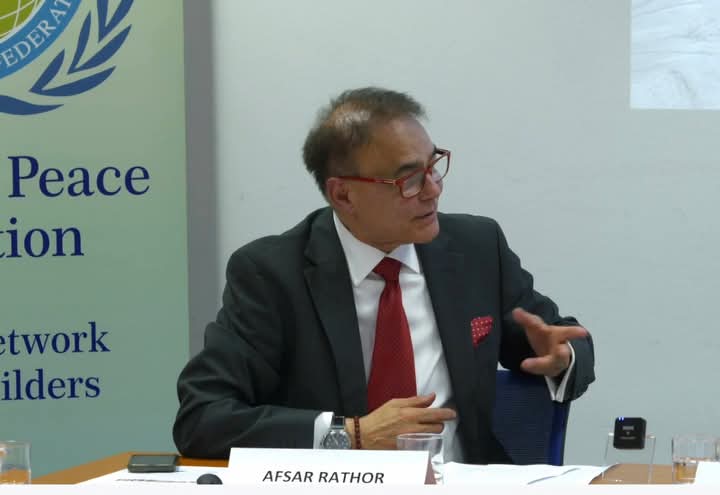
AFSAR RATHOR, former UN Executive (UN Peacekeeping Missions, UNIDO etc.)
Jean-Luc Lemahieu former Director of Policy Analysis and Public Relations at the UN (UNODC):-
One of the most insightful contributions was delivered by Jean-Luc Lemahieu, former Director of Policy Analysis and Public Relations at the United Nations Office on Drugs and Crime (UNODC). His remarks focused on young people and adolescents as a particularly vulnerable target group for any sustainable crime prevention strategy. Lemahieu pointed out that worldwide, a young person is killed by violence every seven minutes. At the same time, around 166 million young people between the ages of ten and nineteen live with diagnosable mental health problems or disorders. His central message, however, was that many risky behaviors do not stem from criminal intent, but from the need for belonging, recognition, and identity. Young people often don’t weigh up “legal” and “illegal,” but rather ask whether they want to be part of a group or excluded from it. Stable role models and positive social spaces—including educational, cultural, sports, and religious communities—are therefore particularly important, as they provide young people with orientation and a sense of belonging.
The Ambassador of Bosnia and HerzegovinaDanka Savić:-
The Ambassador of Bosnia and Herzegovina to the United Nations and the OSCE in Vienna, Danka Savić, shared the experiences of a country still living with the consequences of a war that left deep societal wounds. She emphasized that extremism and violence rarely arise suddenly. Rather, they develop gradually when communities stop communicating with each other and people begin to retreat behind closed identities.
As a striking example, she cited the “Sarajevo Haggadah,” one of the most important Jewish manuscripts in Europe, which was protected by people of different religious affiliations during various historical crises. For Savić, this story symbolizes the capacity of human solidarity to overcome religious and political boundaries. Interreligious dialogue, she believes, does not begin only after a crisis has erupted. Its true strength lies in creating trust and encounters before tensions even arise.
Dr. Androniki Barla, an Orthodox theologian and canon lawyer from Greece:-
The institutional aspect was highlighted by Dr. Androniki Barla, an Orthodox theologian and canon lawyer from Greece. She emphasized that sustainable security cannot be guaranteed solely through prosecution and sanctions. Rather, interreligious cooperation is directly linked to the United Nations’ Sustainable Development Goal 16, which aims to promote peaceful, just, and inclusive societies. Barla pointed out that the major religious traditions share fundamental values – including respect for human dignity, non-violence, and responsibility towards others. Strengthening these values can significantly contribute to fostering a culture of the rule of law and social cohesion.
Professor Ejona Icka:-
The presentation by Professor Ejona Icka, clinical psychologist and director of the International Association of Youth and Students for Peace for the Balkan region, was particularly impressive. Drawing on her work in Kosovo, she described experiences from an international youth summit in Mitrovica, which brought together young people from different communities. She recounted how difficult it had been to build trust between young participants from different ethnic groups over several months. Only a seemingly simple question from her Orthodox husband about a church in her home parish overcame barriers that had existed for a long time within minutes.
For Icka, this was impressive proof that religion can build bridges when used as an instrument of encounter and not of division. She also emphasized that crime prevention begins in the family. Children learn not primarily through words, but through the behavior of adults, which they observe daily.
Dr. Afsar Rathor, former UN official and representative of the Coalition of Faith-Based Organizations:-
The event concluded with a presentation by Dr. Afsar Rathor, former UN official and representative of the Coalition of Faith-Based Organizations. Drawing on decades of experience in conflict regions such as Rwanda, Bosnia and Herzegovina, Somalia, and Kosovo, he emphasized that hatred does not begin with weapons, but with the loss of trust between people.
Rathor presented the work of the Coalition of Faith-Based Organizations in Pakistan, where Muslims, Christians, Hindus, and Sikhs work together on projects to promote social cohesion. He made it clear that respect for religious diversity is not only an ethical principle, but also an effective instrument for preventing extremism, violence, and crime.
Despite the different geographical, cultural, and religious perspectives of the speakers, a common message ran through the entire event: Safe societies are not created solely through punishments and security measures. Security begins where people experience belonging, where differences are understood not as a threat but as an opportunity for cooperation, and where trust becomes part of everyday social life. A common insight emerged from the experiences in Bosnia, Kosovo, Rwanda, and Pakistan: Crime cannot be prevented solely through sanctions, but primarily through building just, inclusive, and resilient communities. Where trust grows and people experience respect and recognition, hatred, extremism, and violence lose their breeding ground.